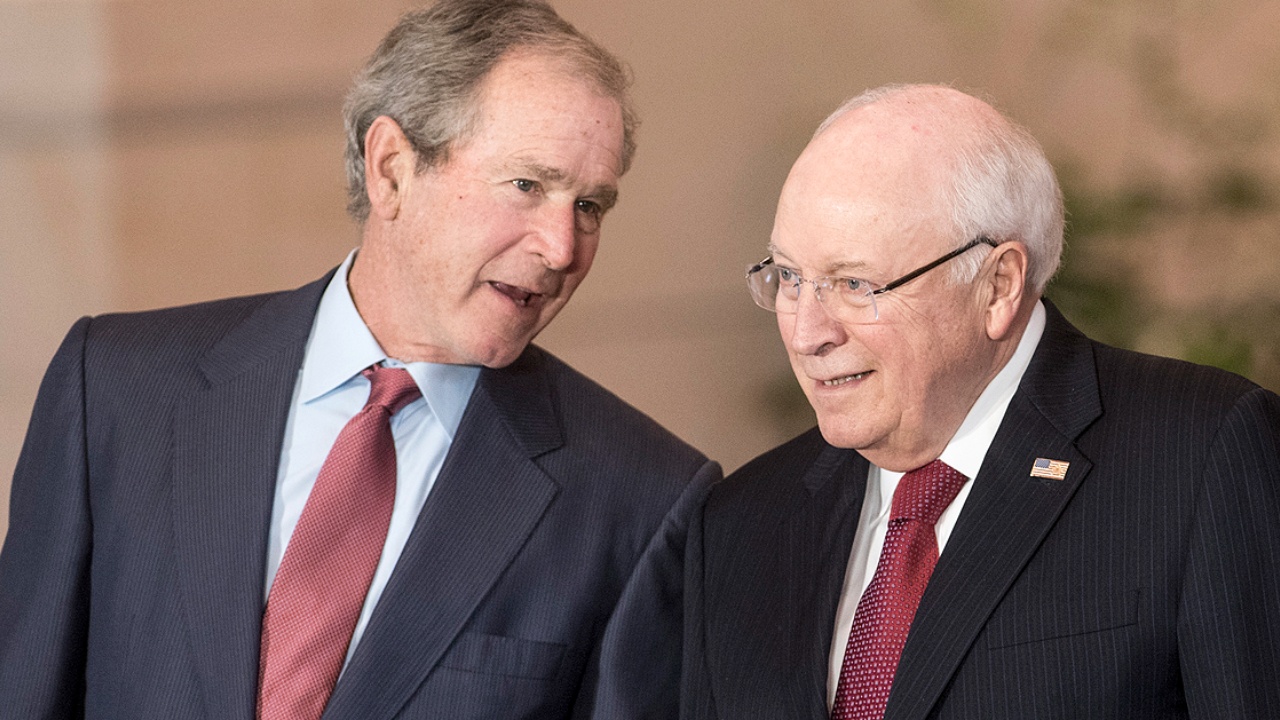
Based on his long and influential career, Dick Cheney was a staunch Republican who served every Republican president from Richard Nixon to George W. Bush. His political identity was defined by traditional conservative principles, a focus on strong national defense, and a hardline approach to executive power, which made his final years in public life particularly striking as he became a vocal critic of a Republican president.
Cheney’s Republican roots ran deep and shaped his entire political career. He first arrived in Washington, D.C., as a congressional fellow in 1968 and quickly began working within the Nixon administration. His rise through Republican ranks was steady: he became the youngest-ever White House Chief of Staff under President Gerald Ford, served six terms as a U.S. Representative from Wyoming, and was appointed Secretary of Defense by President George H.W. Bush.
You Might Like: Dick Cheney’s 2012 Heart Transplant Journey
In Congress, he was a reliable conservative vote, and as Defense Secretary, he oversaw Operation Desert Storm and managed the Pentagon’s budget through the post-Cold War drawdown. After a period in the corporate world as CEO of Halliburton, he returned to public service as vice president under George W. Bush, a role where he was often described as the most powerful vice president in American history.
A Republican Legacy Forged in the War on Terror
Dick Cheney’s brand of Republicanism was most visibly defined by his response to the September 11, 2001, terrorist attacks. From a bunker beneath the White House, he helped coordinate the nation’s immediate reaction and became a central architect of the ensuing Global War on Terrorism. He was a leading advocate for the 2003 invasion of Iraq, famously asserting that Saddam Hussein possessed weapons of mass destruction and had ties to al-Qaeda—claims that were later disproven but were instrumental in building the case for war.
Former Republican U.S. Vice President Dick Cheney has passed away at the age of 84. pic.twitter.com/kpFAqI5FQM
— Pop Base (@PopBase) November 4, 2025
His unwavering stance on national security also extended to supporting the use of “enhanced interrogation techniques” on detainees and holding suspects without trial at Guantanamo Bay, positions that were highly controversial but that he defended as necessary for the country’s protection. Throughout this period, his actions reflected a Republican philosophy that prioritized a robust and proactive national defense.
Also See: The $12 Million Empire of Cheryl Ladd
An Unexpected Final Chapter as a Party Critic
In a dramatic turn of events, the final years of Cheney’s life were marked by a very public break with the modern Republican Party, largely over his opposition to Donald Trump. After the January 6, 2021, attack on the U.S. Capitol, Cheney and his daughter, former Representative Liz Cheney, emerged as fierce critics of Trump’s efforts to overturn the 2020 election results. He called Trump “a coward” and stated, “In our nation’s 248-year history, there has never been an individual who was a greater threat to our republic than Donald Trump.”
This stance led to his political ostracization; he was no longer invited to major Republican events, and many old allies cut ties with him. His break was so complete that in the 2024 presidential election, he endorsed the Democratic candidate, Kamala Harris, urging voters to “put country above partisanship.” This final act underlined that while his allegiance to the Republican Party had ended, his commitment to his own principles, as he saw them, had not.
Dick Cheney’s political journey was that of a definitive Republican who witnessed his party transform dramatically. From a powerful insider shaping conservative policy for decades to a critic standing against what he perceived as a threat to the republic, his life tells a story of unwavering conviction and, ultimately, a difficult political divorce.