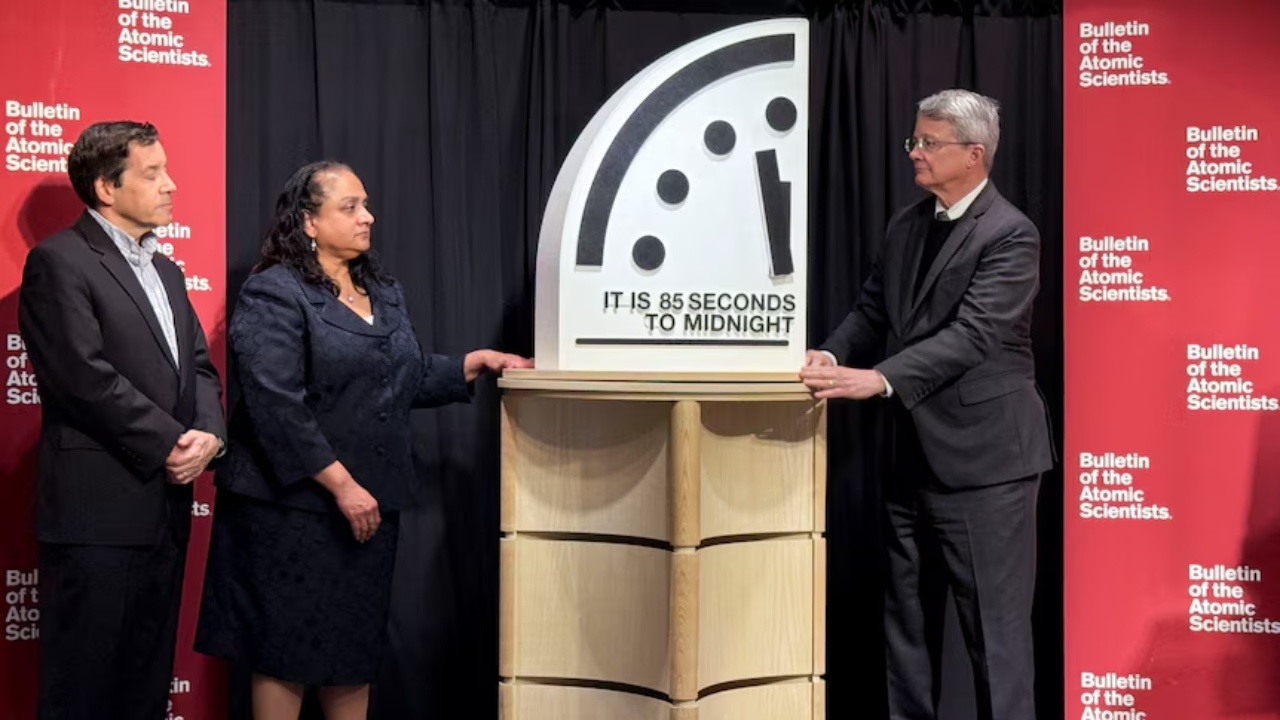
The Doomsday Clock serves as a powerful metaphor for humanity’s proximity to self-inflicted catastrophe, illustrating how close we are to irreversible global destruction through our own inventions. Created in the aftermath of World War II, it represents the collective anxiety over technologies like nuclear weapons, and more recently, climate change and artificial intelligence. Maintained by experts, the clock doesn’t predict an exact end but urges action to avert disaster by highlighting escalating risks in a simple, visual way.
As of January 2026, the clock stands at a harrowing 85 seconds to midnight, the nearest it has ever been to the symbolic hour of doom. This adjustment from 89 seconds the previous year underscores mounting threats from unchecked nuclear proliferation, the unregulated expansion of AI, and potential biological hazards that could spiral into pandemics. The shift reflects a world teetering on the edge, where geopolitical tensions and technological advancements outpace efforts to safeguard humanity.
You Might Like: Quinton Aaron’s Real-Life Partner and Personal Struggles
What Midnight Really Means
Midnight on the Doomsday Clock isn’t just a time—it’s the point of no return, embodying total annihilation from human-engineered threats. When the hands reach this mark, it signals that we’ve crossed into a scenario of widespread devastation, such as a full-scale nuclear exchange that could end civilization as we know it. The clock’s creators chose this imagery to evoke urgency, much like a ticking bomb in a thriller, but grounded in real science and policy failures.
BREAKING: The “Doomsday Clock” has moved to 85 seconds to midnight, the closest it’s ever been. pic.twitter.com/SOO3Vzn8Qo
— Leading Report (@LeadingReport) January 27, 2026
This symbolism has evolved over decades. Initially focused on atomic bombs, midnight now encompasses broader perils, including environmental collapse and emerging tech gone awry. For instance, if international treaties fail and AI systems trigger unintended conflicts, or if climate tipping points are breached, the clock edges closer. It’s a reminder that midnight isn’t inevitable; pulling back requires global cooperation, disarmament, and ethical innovation to rewind the hands.
The Bulletin of the Atomic Scientists
The Doomsday Clock is overseen by the Bulletin of the Atomic Scientists, a nonprofit organization founded in 1945 by researchers from the Manhattan Project who sought to educate the public on nuclear dangers. Their Science and Security Board, comprising leading scientists, policymakers, and experts in fields like nuclear physics and climate science, convenes annually to assess global risks and adjust the clock accordingly. This group consults with international colleagues to ensure a comprehensive view, making decisions based on evidence rather than alarmism.
Also See: Quinton Aaron Net Worth 2026 – Health Battles & Crowdfunding
Since its inception in 1947, the Bulletin has reset the clock 27 times, with the farthest point at 17 minutes to midnight in 1991 after Cold War arms reductions. Recent years have seen it creep perilously close, hitting 100 seconds in 2020 amid rising tensions and pandemics. In 2026, the board’s warning emphasizes the need for binding AI regulations and biological threat pacts. Through publications and advocacy, the Bulletin influences leaders, pushing for policies that could one day set the clock back further from midnight, fostering a safer future for all.